Colony’s action and passion outweigh its flaws
We’re merely two weeks off of the re-release of director Yeon Sang-ho’s beloved Train to Busan, which proved itself to still hold up more than well after ten years, earning itself a rightful place in the Hall of Fame of zombie horror. And following just behind is the exciting and terrorizing Colony, also from Sang-ho. It’s a hard follow up for what is not even the second nor third zombie flick from the director, and it falls short by merely a few steps of meeting its sibling's ranking.
Colony is a two-hour thriller, with an abundance of characters leading it that never fail to make it a bore.
In fact, some of the roles we see here even feel familiar, which isn’t shocking based on Sang-ho’s previous character work. He proves yet again that he can take on any setting for the world of the undead, inventing ways to turn these people into something that every person in an audience can take something from. Although the repetition of certain arcs, character types or even the typical poor survival choices at times bring Colony down right as it carries itself high, it sets itself apart from the feat that is Busan, giving itself and Sang-ho a much needed detachment from his previous films and their universe.
Our central location is a large building in Seoul, where we’re thrown into the middle of a conference held by a leading bio engineering company’s CEO, Kang Woo-chul. This is mere minutes after our opening where a scientist recently fired by Kang, Kwon Se-jeong, phones in a direct tip to the police, where he swears to commit an act of bioterrorism. It’s a straightforward set up for the audience to immediately understand what violence is coming for us, though it comes off as exposition before we earn the chance to understand what will set off the chain reaction of infection. But for a two-hour runtime, this isn’t exactly a bad thing; because the action awaiting us is more than a simple treat. The fast moving opening comes with the added speed of introduction of every survivor, and soon to be victims. It’s a bit sporadic, as we push through the moving parts with just enough time to collect our thoughts about who we need to keep our eyes on. It settles the pacing as quickly as it comes, pushing us into the action without laying in wait.
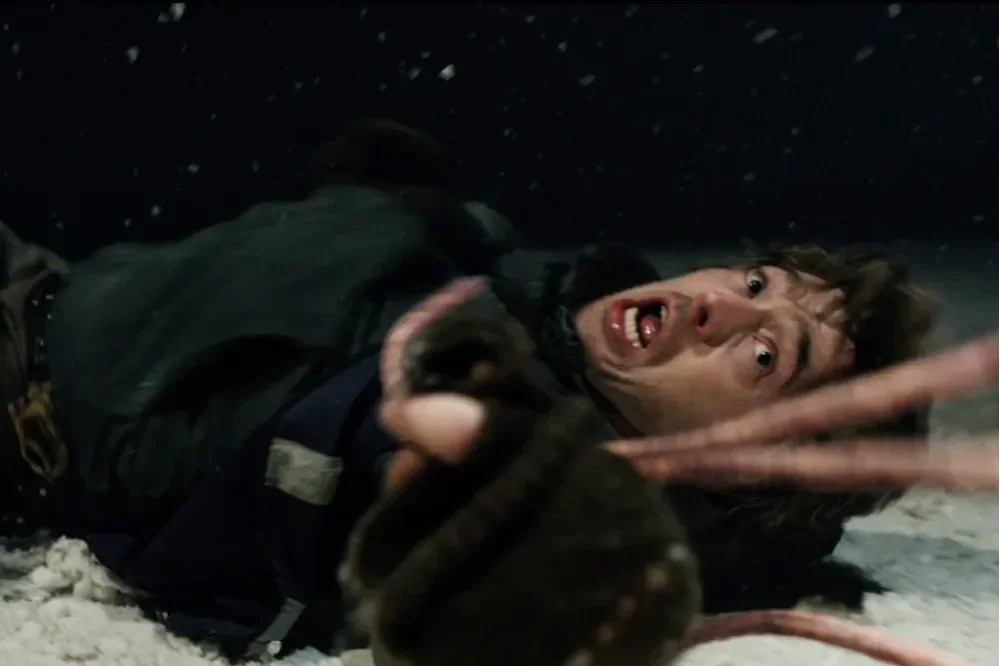
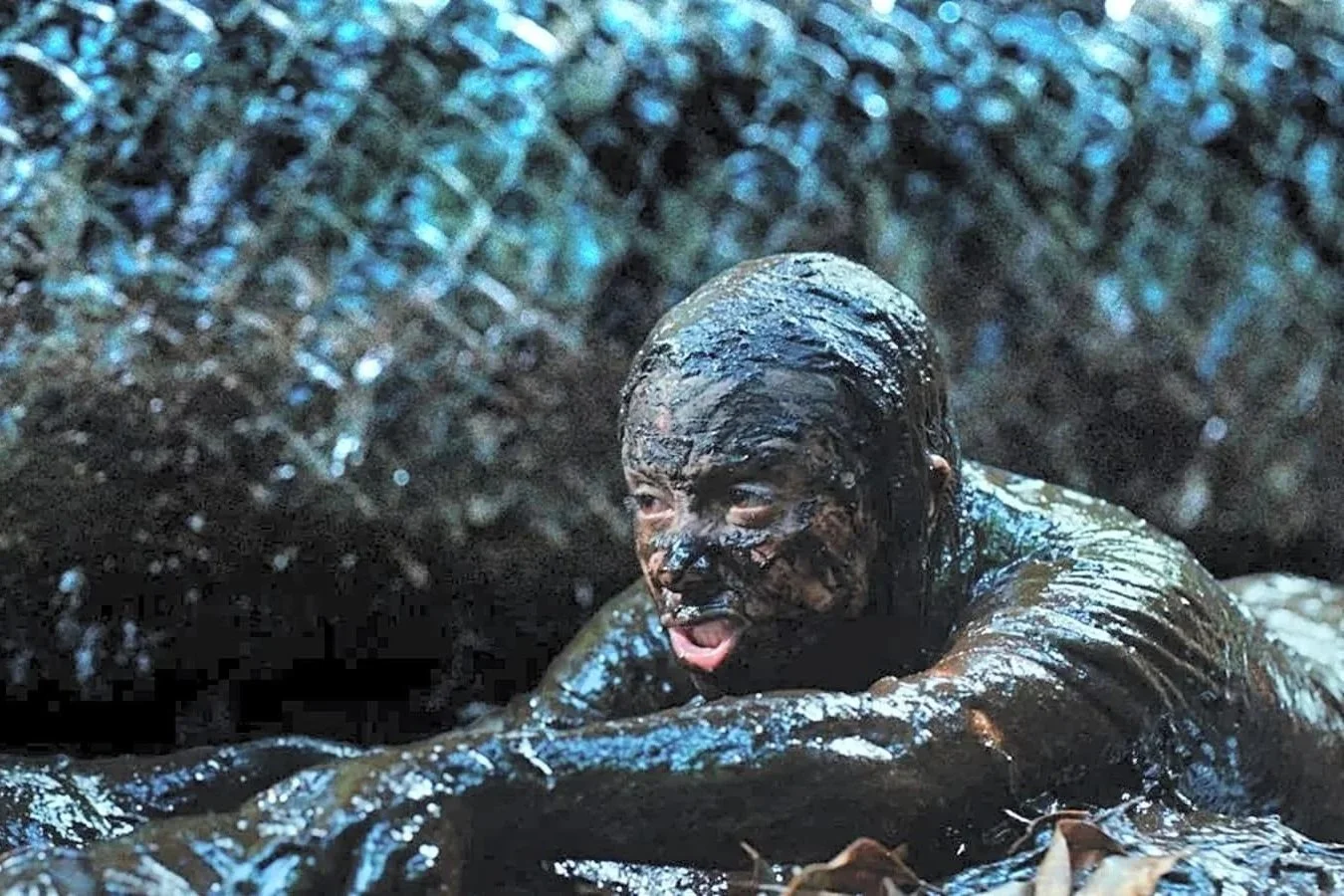
While the infection spreads even quicker than seen in Sang-ho’s zombie work, there are notable differences between these zombies and the ones we’re already familiar with. The infected in Colony resemble actual ant colonies, adapting and communicating through signals throughout the film in a chilling, siren-like scream when they take in information. Even in the moments where the film loses its footing, the continuous act of the creatures “speaking” to one another instantly alerts us that we’re about to witness our survivors even further. We also receive a direct view at patient zero at the moment of being turned, when the spiteful Kwon inserts a slime-like virus into the neck of Kang. As expected, however, he turns by the time he can blink, vomiting slime and running on all fours.
During development, Sang-ho and co-writer Choi Gyu-seok conceptualized the idea of the film playing out similar to a video game, hence the “jumping” feeling between our survivors who begin to serve as characters with different necessary skills based on the situation. It was an idea designed to counteract the always evolving infected, preventing the scenes from feeling stale while we, and the characters, sit with the knowledge that there is no singular plan that will keep them safe.
Along with changes to the infected’s knowledge or brain activity, the creatures emit a white slime, which grows like mold that encases the building as our leads continue moving closer to their escape. It makes for a fantastic bit of set design, even while it tends to exist solely in the background. The characters and infected make their way with the constant sound of the slime’s sloshing and sticking, or infected peeling away from each other while the slime serves as a glue. Another aspect of the infected comes in the form of a direct connection to Kwan, as we learn that he not only infected himself, but he serves as their unofficial leader, controlling them with his own signals to the furthest point of making them able to speak. It’s a terrifying ability, one that he uses to trick two of the younger survivors into opening a door by making the infected speak as if they are a rescue team. Kwan himself makes the film feel larger than life at times, in part due to a stunning performance by Koo Kyo-hwan, who plays Kwan as the cunning threat who lurks even when those around him feel they are finally safe. The same can be said for the majority of our final survivors, with each actor playing to their strengths that allow for the typical scene in a horror film to extend beyond itself with the emotional touches that come from the performances. The chemistry between each member of the group, even when it turns sour when the real fear of dying overcomes their desire to keep one another alive, more than helps the script in its weaker moments.
Even though the idea of loosely using the format of a video game is an interesting one, it took away from the chance to build upon our characters in the way that we know Sang-ho is capable of. Some scenes even feel like pure set up for a character to make a poor decision, more so than the typical fool in a horror movie. It was disappointing to see people who held it together for the majority of the film, or served their purpose strongly, suddenly make a choice that is on the opposite end of the spectrum we have seen them on during their screen time. Each of these occasions results in a death, some emotional and some are gnarly, but not all of them feel worth it - even as every cast member gives their all..
Sang-ho’s work following Train to Busan have all been held to a high standard that many believe that he has not been able to reach again; but that sentiment is a hard one to follow when he still proves to be spectacular at designing a monster anyone would fear. Even in this case where we don’t have enough dedicated time to learn about the people on the screen, the smaller moments where many reach their end manage to overcome what their lack of history can make you feel - or rather, not feel. It can of course be distracting from an otherwise typical plot of a bio-weapon gone wrong, but when the story is point blank telling you that the bio-weapon was doing its intended purpose of wiping people out, you can easily continue to pick up favorite moments in this script regardless. There’s stable bones in this story, we just get a bit turned out and tied up along the way.