Routine: The scariest game I’ve ever played?
It’s June 9, 2022. As I scroll through Twitter, I see people buzzing about a trailer that just debuted at Summer Game Fest for an indie title called “Routine.” Curious, I decide to give this “Re-Reveal” trailer a watch.
It wows me with the game’s stunning graphics and retro-futuristic art-direction. It intrigues me with the immersive way that the player operates their C.A.T. (Cosmonaut Assistant Tool—more on that later). This game looks awesome, and I need to play it when it comes out. This excitement will be the reason that I end up deciding to finally get a gaming PC, ensuring that I would be able to play Routine whenever it finally landed.
Routine wouldn’t be released until years later though, on Dec. 4, 2025. By this point I had gained my fair share of experience playing horror games, and I had successfully lobotomized my Steamdeck to convert it into a desktop Windows PC.
Now, after a few months following its initial release, I’ve finally gotten the chance to play and finish the game. And honestly? I’m a little surprised that I haven’t seen it get the flowers that it deserves.
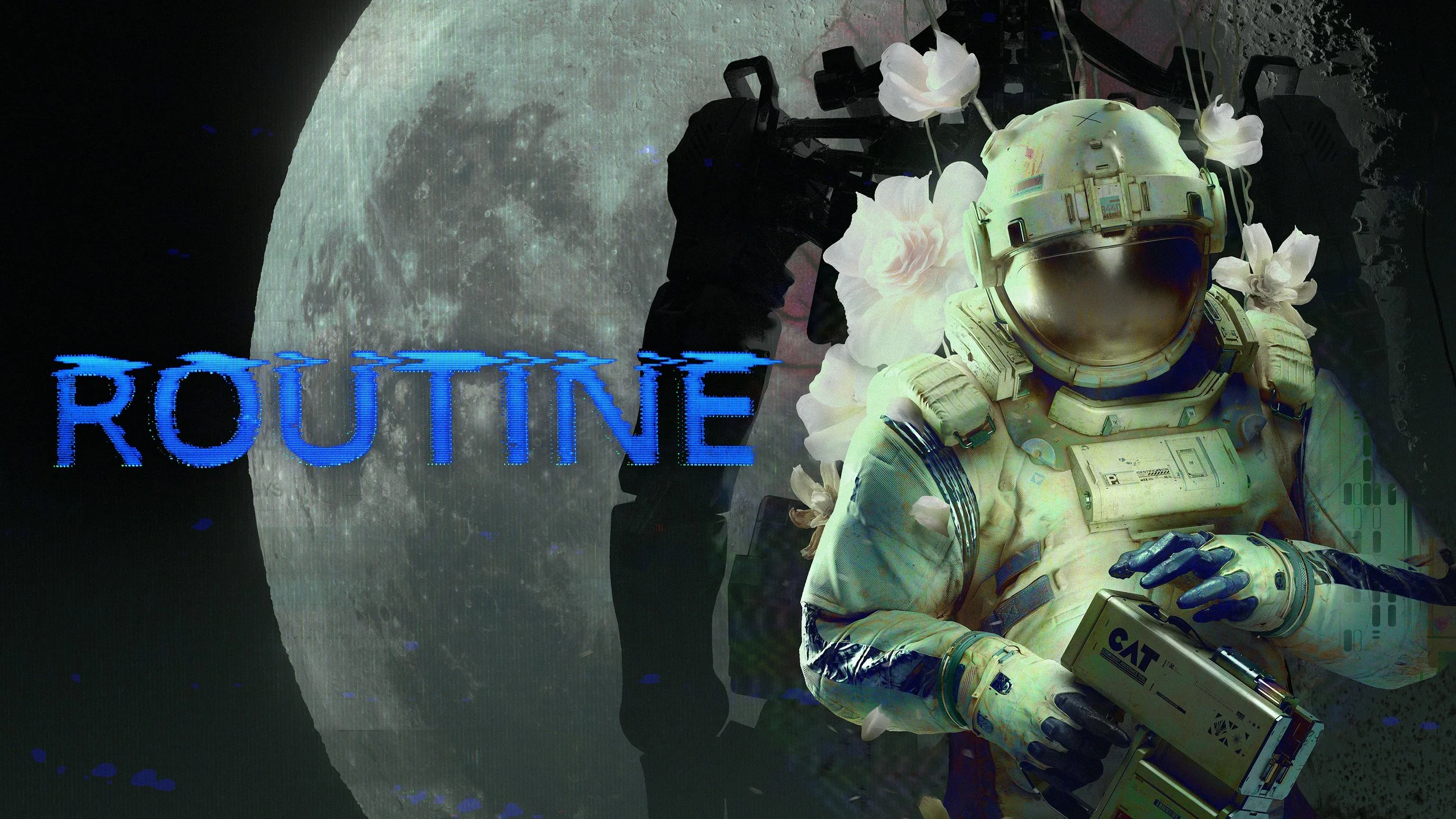
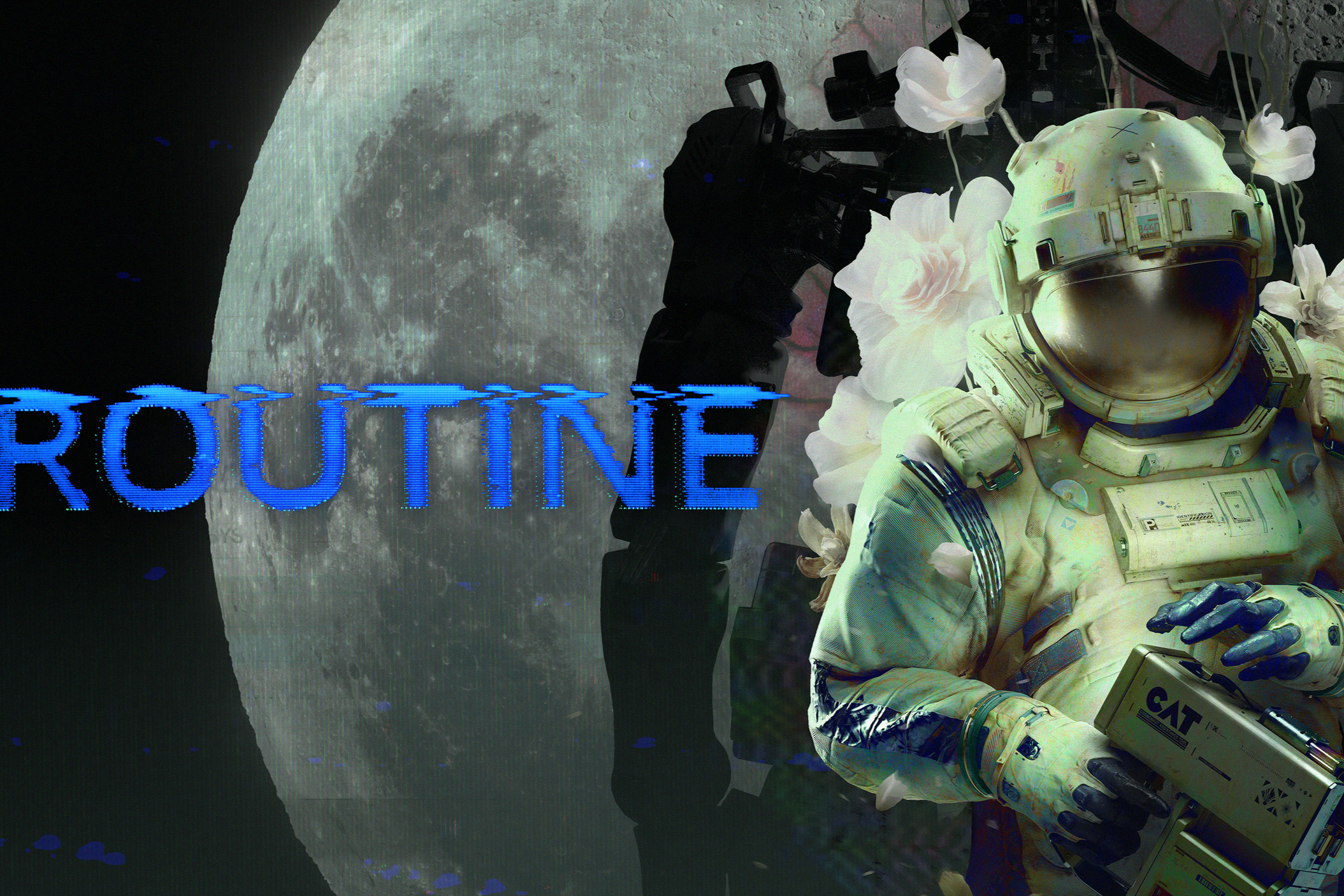
An indie project 13 years in the making by Lunar Software, Routine (2025) is a first-person sci-fi horror game set on an abandoned lunar base designed around an ‘80s vision of the future. You play as an unnamed senior software engineer who’s been sent to Union Plaza, a resort located on the moon, after one of their core systems starts acting strangely. By the time you arrive, it’s empty (and messy, too). Worse, the AI seems to think that you are the problem, and will try to kill you on sight. With no way of escaping, the only way out is through.

Routine delivers on what it had shown in that 2022 Re-Reveal trailer and then some, possessing that same gorgeous presentation all throughout its playtime. So much love, attention, and care was put into building each and every individual detail of this game’s world.
It’s a massive love-letter to the cassette futurism seen in movies like Alien (1979), yet its identity manages to stand on its own. Not only that, but it also has a compelling horror atmosphere that honestly got to me. Whether it be the desolate corridors of the once-bustling Union Plaza that have now fallen into disarray, or the grungy maintenance tunnels below a long-forgotten Ward, the world of Routine is full of memorable locations and scenery that are sure to burrow under your skin and stick with you.
I could honestly gush about how this game looks for hours, but Routine’s atmosphere would only be half as effective were it not for its incredible sound design and music. Every sound and track feels so distinct to the world of Routine. Many sounds are cold, mechanical, and complex; others range from strangely beautiful to deeply unsettling, yet always haunting in one way or another.
Again, I could go on and on, but the most noteworthy example for me personally is something that lurks later in the game. I wouldn’t dare spoil the surprise, as this game is best experienced as blindly as possible, but believe me when I say that there is something much, much worse waiting for you in Routine than the rogue AI at its forefront. You know how whenever you’re taking a shower and you’re washing out the shampoo in your hair you may get the irrational fear of someone or something else being in the room with you while you’re vulnerable? I haven’t had that feeling in years until I played this game, and every once in a while I’d get scared of hearing that thing’s sounds as I washed my face, and that I’d open my eyes to see… well, you’ll have to play the game yourself to find out.
This isn’t just a testament to the sounds of Routine, or even to the dreadful thing that I’m vaguely discussing; it’s a testament to all of the brilliant ways that this game builds tension, and how it scares the player as a whole. It’s for this very reason that sometime after the halfway mark, I wasn’t sure if I’d be able to finish my playthrough. It’s also why Routine may be the scariest horror game I’ve ever played.
As such, the environment and sounds of Routine aren’t the only aspects of it that Lunar Software put a lot of thought into; the same goes for everything else. This brings me to the gameplay of Routine, which could be the most immersive of any game that I’ve had the pleasure of experiencing. The game has no HUD or UI aside from control instructions at the start and a small reticle that only appears when hovering over interactable objects. Instead, everything is diegetic.
You want to interact with a monitor? Just walk up to it; your aiming reticle will seamlessly turn into the mouse cursor on the screen, and you can move it around to click on whatever you want. Want to change the module on your C.A.T. or use it to hook up to a screen? Flip it on its side and hit its various switches and buttons. My descriptions probably aren’t doing the immersion of Routine justice, but I promise, it’s not like anything I’ve played before.
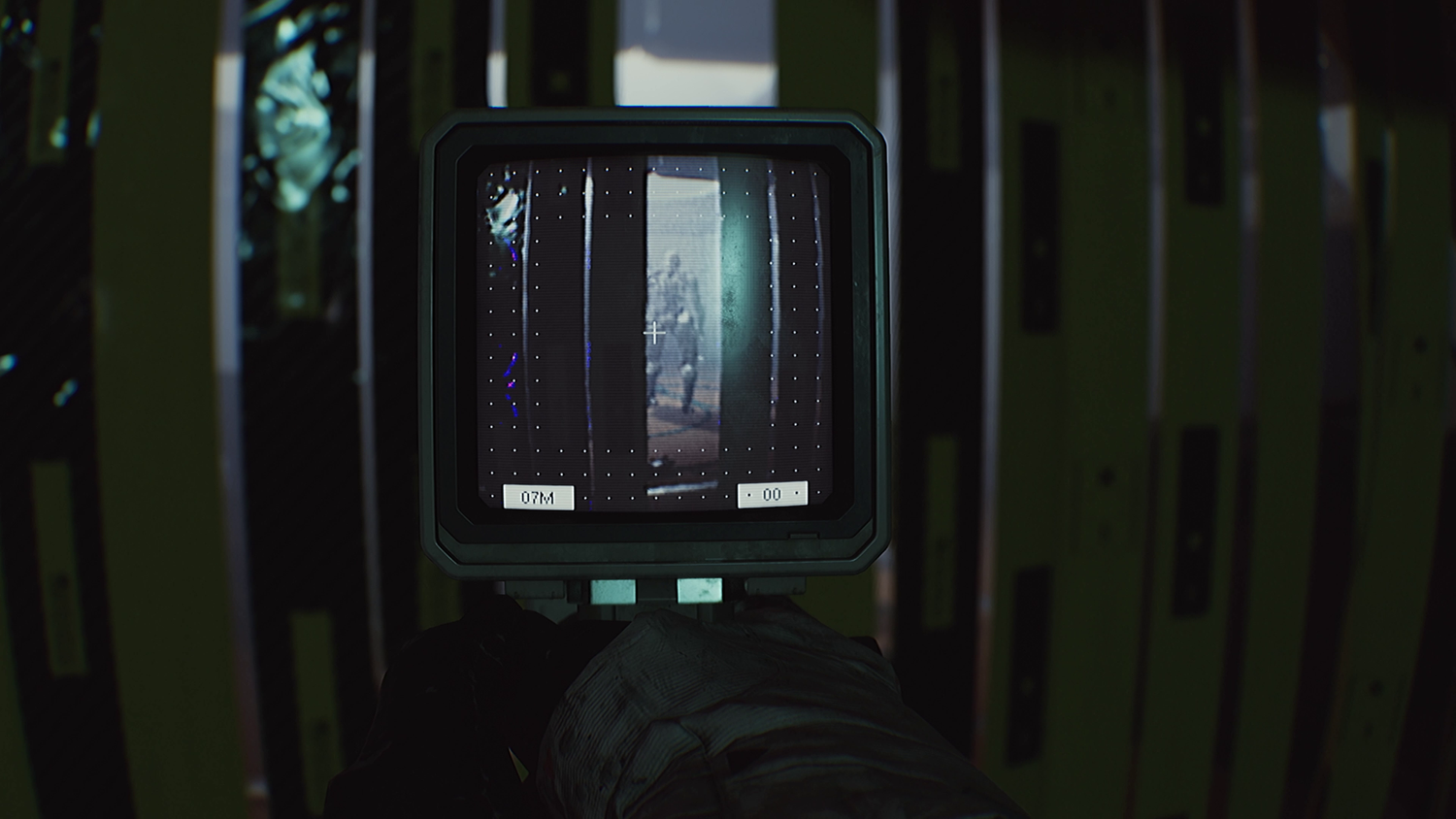
Speaking of the C.A.T., this Cosmonaut Assistant Tool is at the heart of Routine’s gameplay. It’s a retro-futuristic multi-tool that the player gets at the start, powered by lithium ion batteries scattered around. Although it’s needed to save and check your objectives, the C.A.T.’s primary uses are navigation, puzzle-solving, and defense as a last-resort. It smoothly does all of these things at once, and in ways that make perfect sense in-universe.
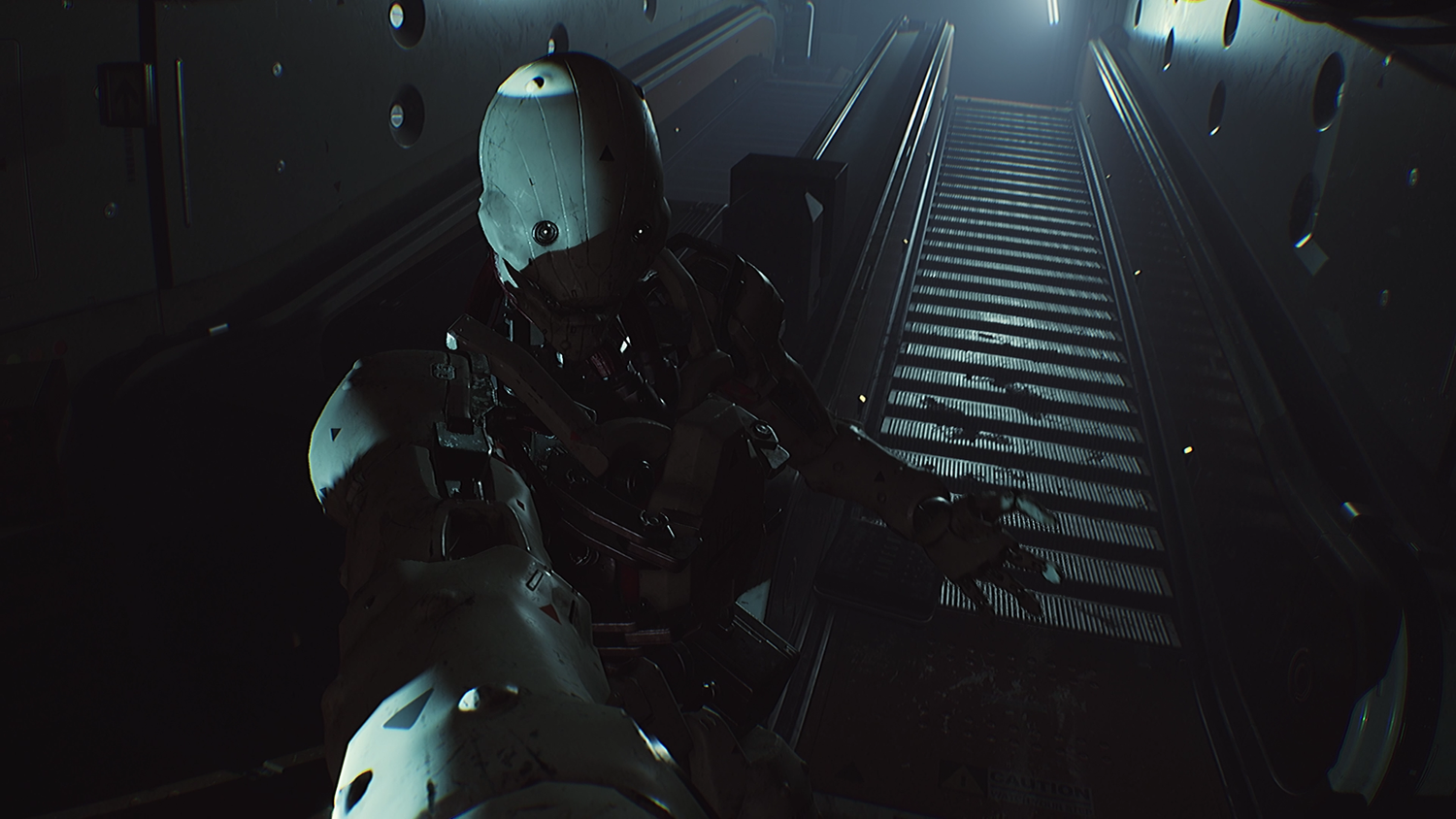
For example, you start out with only the Engineering Module. The C.A.T.’s base module fires a burst of electricity at the cost of ⅓ of its battery. This allows you to reactivate doors or overload circuits, however, it can also be used to stun a Type 05 Security Bot if one happens to spot you. But like I said earlier, defense is a last-resort; the stun only lasts for 10-15 seconds, and that’s if the Type 05 doesn’t dodge or block the shot. Because of this, the C.A.T. is also very effective in complimenting the horror of Routine. There was a moment later on when I was running away from a threat, stumbled into a locked door, panicked, and spammed the C.A.T., only for it to be unsuccessful and result in my neck getting snapped.
Lastly, there’s the story. I won’t touch on it more than I already have because Routine is intentionally vague with its narrative. Nothing is spelt out for you; instead, details are thoughtfully planted, logs are written with intention behind how much it says or reveals to the player, and so on, all pointing towards something greater beneath the game’s surface without pulling the curtain all the way back. To tell you the truth, I didn’t fully understand Routine’s narrative when I’d finished it. I still don’t, even as I write this. But I’ve enjoyed making my own theories and interpretations, and if I wasn’t a wimp, I’d go back and replay the game just so that I could analyze everything after having experienced this fascinating narrative in full. If you enjoy carefully crafted and subtle psychological stories that don’t hold your hand at all, I think you’ll love this.
After singing the praises of this wonderful indie game for so long, I’d be remiss if I didn’t mention the few flaws I had with Routine. For one, you can’t truly “pause” the game. There’s a pause menu, sure, but the game itself keeps going while it’s up. This means that, unless the player has secured themselves in a hiding spot or safe area, they’re 100% susceptible to receiving a game over from an enemy stumbling upon them.
But my main issues have to do with the game’s vagueness and pacing. For the most part, both of these are executed quite well. However, there are moments where the game is too vague for its own good. I only struggled with this a few times, since I knew to keep a close eye out. However, one of those times had me wandering around for at least a half hour because I wasn’t sure what I was supposed to do or where I had to go. I had to ask a friend of mine who had played further ahead than me what I was supposed to do, and when they told me, I facepalmed from a mixture of “I can’t believe I didn’t try that” and “how would I have known to do that when every other instance of this didn’t signify that I was able to?” This was during Chapter 4 of the game, which is also where the pacing drags. It’s the only chapter that overstays its welcome. I suppose it’s only fair after how short Chapter 3 was, but still.
Having said that though, I hope that these flaws don’t deter you from playing Routine if anything else I’ve written about it has piqued your interest. It’s a labor of love from people that have an immense passion for horror, video games, and a version of the future that only exists in the sci-fi films of the 1970s and ‘80s. It’s a short game, and well-worth the price.
Routine is available on Steam, Xbox One, and Xbox Series X|S for $24.99.